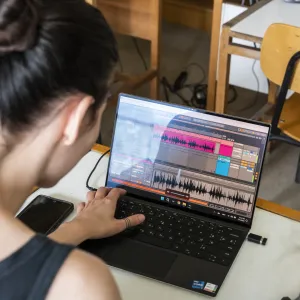


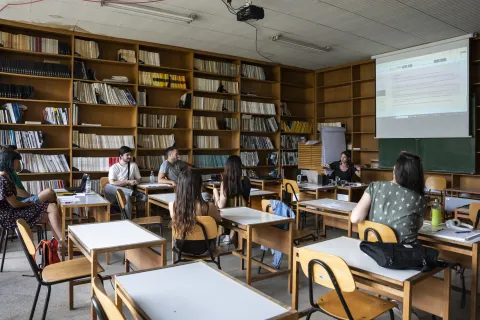


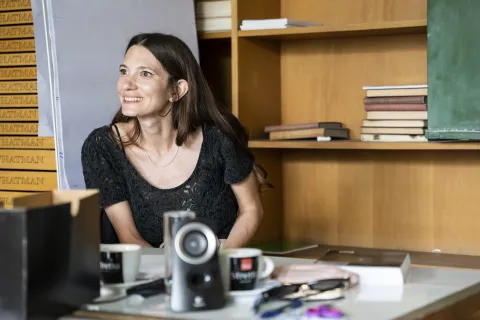


The aim of the workshop is to introduce participants to the fundamental principles of the creative process of songwriting, to demystify that process, and to help them overcome their own preconceptions and/or creative barriers. With guidance, participants go through the entire process of creating a song: from the initial idea, through the relationship between lyrics, rhythm, and melody, to the basics of arrangement, audio recording, and music production. The participants’ recorded songs remain as a lasting document of their work and progress, as well as a valuable incentive for their continued exploration and creative development.
A few years ago, when I was already a relatively established artist, I began receiving invitations to lead workshops. Since we live in a society that likes to categorize things and put activities into neat little boxes, I immediately ran into the problem of what exactly to call what I do. I compose music, but I graduated from neither a music academy nor a secondary music school. I write lyrics for that same music, but I certainly wouldn’t call myself a writer. I develop concepts for artistic works, but I have no formal training from an art academy. I work in music production, but I am not a conventional music producer. I am a singer-songwriter, but definitely not in the narrow, traditional sense of the term. What I do brings together knowledge and disciplines from many different fields, without being narrowly specialized in any one of them: composing, lyric writing, arranging, music production, recording, performing, and developing and creating the sonic and visual identity of a work. So what is it, exactly, that I actually know how to do—and what of that could I pass on to other people?
It turned out that this very process—a little bit of everything—is precisely what people find interesting, and what can be liberating for the creative potential of many. I am aware that this may sound like a cliché, but if you truly apply yourself, if you feel the urge and have the will, you can unlock knowledge and develop skills you never thought possible. That, at least, has been my experience. Of course, physical limitations do exist: with a prescription of -6.00, you cannot become an airline pilot, just as becoming a surgeon might prove difficult if you faint every time you see blood. But when it comes to writing and composing songs, all you really “need” is goodwill, curiosity and persistence.
This is why I decided to call the workshop “How Songs Are Made” and designed it as a multi-day program in which participants go through the entire process with me: from writing lyrics and melodies, through harmonization and arrangement, to recording audio, active listening and analysis, and finally the basics of music production.
The goal is for participants to produce a demo version of their own songs by the end of the workshop, trying their hand at each of these processes through their own concrete example and coming away with a tangible result. At its core, the workshop is about demystifying the creative process—that is, providing a basic “toolkit” or “set of skills” that participants can continue developing in a variety of directions.
Of course, any prior knowledge helps; in my own case, it was elementary music school, where I studied violin. But it is by no means necessary. It is also possible to discover seemingly unexpected connections with experiences from entirely different areas of work and life that can prove useful in the creative process. My education in architecture—a technical field—showed me that composing is surprisingly comparable to designing, but also to directing. Scientists might recognize a similar process of connecting their own work with the kind of intuitive yet “organized” creative energy found, for example, in dance, and I believe similarly surprising parallels could be found in many other professions. Writing and composing are deeply personal and intuitive acts, but at the same time they follow certain principles—and it is only once we uncover those principles that we can truly let our creativity run free.
I should also add that I firmly believe the process of passing on knowledge should be warm, encouraging and gentle. There are enough inner struggles involved in creating as it is, not to mention the challenges awaiting anyone who actually decides to pursue artistic creation. There is therefore no reason for the process of learning to make things any harder. Songs in the making are fragile creatures, regardless of who is nurturing them.
My role as a workshop leader is to encourage participants, empower them, ask questions, even play devil’s advocate when necessary—but ultimately, to help them push the door open and show them that exciting things are possible.
— Sara Renar, 2024